
How to Pitch Your Work So a Funder Says “Yes”: Insights from a Client Session
Picture This:
You’ve spent months crafting the perfect proposal. Your research is solid, your mission is clear, and your impact is undeniable. But when you finally meet with potential funders, something goes wrong. Instead of nodding along, they’re asking more questions than you expected. Instead of excitement, you see confusion.
If this sounds familiar, you’re not alone. I recently worked with Joanna, founder of Conquer Addiction, who was facing exactly this challenge as she began to fundraise for Conquer Addiction’s moonshot to help one million more Americans recover from addiction by 2030. Her groundbreaking work in addiction treatment was getting lost in translation when she presented to funders.
Here’s what we discovered together— and how you can apply these insights to transform your own funding conversations.
The Problem: When Expertise Becomes a Barrier
Joanna came to our session concerned. After recently presenting the moonshot to a seasoned industry professional, he had walked away with “so many questions” instead of enthusiasm. His feedback was clear: the presentation was way too technical.
Sound familiar? Here’s the truth: your deep expertise can actually work against you in funding conversations.
When you know your work inside and out, it’s natural to want to share every detail— every methodology, every nuanced finding. But funders aren’t looking for your project plan; they’re looking for a solution they can believe in and support.
The Shift That Changes Everything
The breakthrough came when we reframed Joanna’s approach entirely. Instead of walking funders through her research methodology, we helped her tell a story of unmet need, proven solutions, and scalable impact.
Because the truth is that the organizations that get funded aren’t always the ones doing the most important work— they’re the ones who can clearly communicate why their work matters and how it will succeed.
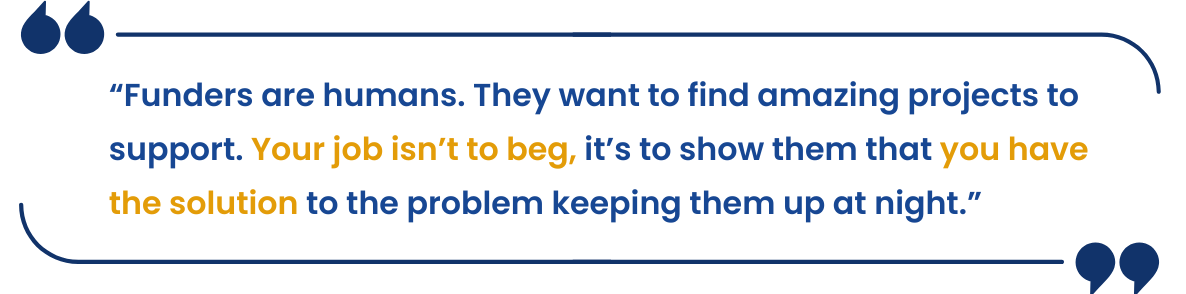
As I often tell my clients:
(More on that in the podcast I did with Tony Martignetti.)
Here’s the framework that transformed her presentation:
1. Start With a Familiar Analogy
Rather than diving into technical details, Joanna began with a powerful analogy. In 1973, the U.S. government created a cancer registry to track treatment protocols and survival rates. The result? Cancer recovery rates improved from 30% to 75% over 40 years. This is what the Moonshot will do for addiction treatment.
Why this works: Funders immediately understand the concept and see the proven track record. You’re not asking them to believe in an untested theory— you’re showing them a replicable success model.
Your application: What proven model exists in another sector or geography that mirrors your approach? Lead with that familiar success story before introducing your innovation.
2. Connect Personal Mission to Systemic Change
Joanna’s connection to this work was personal— her daughter had struggled with addiction. Yet she hadn’t shared that story in her presentation. I reminded her: “Funders invest in people who are in it for the long haul. When they see your personal connection, they know you won’t walk away when challenges arise.”
Personal stories don’t just create emotional connection; they demonstrate commitment and staying power.
3. Show the Gap, Then Show Your Bridge
Instead of overwhelming funders with complex research methodology, we created a visual “checklist” approach. Joanna could show exactly what had been accomplished (✓) and what gaps remained (○) for complete impact.
This shift transformed her presentation from data overload to a clear snapshot of progress and potential. Funders could instantly see how their investment would bridge the final gap.
💡 Want expert guidance refining your pitch? Book a discovery call
The Three Presentation Pitfalls That Kill Funding Conversations
Pitfall #1: Leading with Process Instead of Outcomes
What Joanna was doing: “First, we’ll build a predictive model using claims data, then we’ll apply it to 23,000 patients, then we’ll validate...”
What we changed it to: “We’re creating a way to predict recovery outcomes from insurance data, giving every treatment center and insurer clear visibility into what’s actually working.”
Takeaway: Lead with the transformation you’re creating, not the steps to get there.
Pitfall #2: Burying the Controversy
Joanna’s research challenged government recommendations— a potentially explosive finding. Her instinct was to hide it in technical details. We reframed it to: “Our data is showing us something critical that current official recommendations miss.”
Why it matters: Controversial findings, presented strategically, prove you’re doing groundbreaking work.
Pitfall #3: Assuming Technical Depth Equals Credibility
Complex work tempts you to prove expertise through detail— but this can backfire. Keep your main presentation focused on impact and create backup slides for data enthusiasts.
The Technical Details Still Matter (But Not Where You Think)
The technical rigor of your work matters, but there’s a time and place for it:
During the pitch: Focus on outcomes and proven models.
In the proposal: Include full methodology.
In follow-up meetings: Dive deeper with interested funders.
Think of your presentation as the movie trailer, not the full documentary— it should spark excitement and confidence.
The Visual Element That Wins Funding
We also transformed Joanna’s dense slides into a simple visual journey:
The Problem Slide: 280,000 Americans die annually from addiction, with no improvement in treatment effectiveness since 1993.
The Proven Solution Slide: Cancer registry success story with clear before/after outcomes.
The Early Results Slide: Joanna’s initial data showing the same promising trajectory.
The Scale-Up Plan Slide: Checklist showing completed milestones and what funding will unlock.
Key insight: Funders need to see the path from problem → solution → scale. Make it visual. Make it simple. Make it unforgettable.
Then, we worked on the design. Joanna’s slides initially looked dated, but design is more than aesthetics— it signals credibility.
Why design matters:
Professional visuals reflect competence.
Clear graphics simplify complex ideas.
Consistent design builds trust.
Simple upgrades: Use brand-aligned colors, clean fonts, generous white space, and high-quality visuals. Keep slides under 30 words each.
The Confidence Factor: Why Your Energy Matters More Than Your Slides
Funders invest in confidence as much as they invest in ideas.
Before the meeting: Practice until it feels natural. Prepare for tough questions.
During the meeting: Use confident language— “When we implement this,” not “If we get funding.” Reference data with assurance.
After questions: Pause, breathe, and respond thoughtfully. It’s okay to say, “That’s a great question. Let me follow up with a full response.”
💡 Struggling with presentation confidence? Let’s strengthen both your message and delivery. Work with me → Book a discovery call
The Measurement Question Every Funder Will Ask
“How will you measure success?”
The Three-Layer Framework:
Activity Metrics: What you’ll do (services, programs, people served).
Outcome Metrics: What will change (behaviors, skills, knowledge).
Impact Metrics: What will improve long-term (systems, communities, sustainability).
Lead with impact, support with outcomes, and prove with activity metrics.
Common Mistakes That Sabotage Even Great Presentations
The “Everything is Urgent” Trap: Choose one key message. Funders need clarity.
The “We Do Everything” Problem: Focus on one initiative to demonstrate impact.
The “Humble to a Fault” Issue: Own your success— include awards and testimonials.
💡 Want help identifying your own presentation pitfalls? Book a discovery call
From Transaction to Partnership
The best funder relationships go beyond a single grant.
During your presentation, plant seeds for long-term engagement. After funding is received, provide meaningful updates, invite funders to experience your work firsthand, and involve them in strategic decisions. (For more guidance on how to build this relationship with funders, check out my blog post on Strengthening Donor Relationships.)
True partnerships lead to multi-year support, introductions, and advocacy for your mission.
The Follow-Up Strategy That Seals the Deal
Your presentation is just the beginning. What happens afterward determines whether you get funded.
Within 24 hours: Send a thank-you email referencing specific conversation points and answering any questions that were pending. Attach your detailed proposal, and potentially include a strong visual reminder from your presentation. Suggest next steps.
One week later: Email again to follow up on next steps if they aren't already moving forward.
Why this works: It keeps you top of mind and demonstrates the persistence funders value.
The Framework You Can Use Today
Whether you’re working in healthcare, education, or environmental justice, this framework applies:
Find Your “Cancer Registry” Story: What proven model mirrors your approach?
Position Personal Investment as Strategic Advantage: How does your personal story reinforce your credibility?
Create Visual Proof Points: Show progress and gaps visually.
Separate Pitch from Project Plan: Lead with the transformation; back it up with the execution plan.
Introduce Controversial Insights Strategically: Timing and framing matter.
Putting It Into Action
This Week: Audit your current presentation using this framework.
This Month: Redesign slides with visual proof points.
This Quarter: Test and refine your new approach with real funder feedback.
💡 Ready to transform your funding conversations? I help social impact leaders turn complex work into compelling funding stories. Book a discovery call
The Ripple Effect Beyond Funding
Clear, compelling communication improves everything— staff recruitment, board engagement, community support, media coverage, and partnerships.
When people understand and believe in your mission, your impact multiplies.
Final Thoughts: Your Mission Deserves Resources
As I told Joanna— and every client I work with— your mission deserves to be funded.
The world needs the work you’re doing. The communities you serve depend on your success. And that success depends on communicating your value clearly and compellingly.
This isn’t about oversimplifying your work; it’s about giving it the voice it deserves.
You can learn more about, and support, Conquer Addiction’s Moonshot to save 1 million lives!
💡 Ready to make your next funding conversation a confident “yes”? Let’s turn your expertise into impact. Book a discovery call to get the details on how I can help you.